
Petros C Mavroidis is a Non-Resident Fellow at Bruegel
Three main claims are made against China in modern trade policy discourse: 1) it subsidises its exports, 2) it under consumes and 3) it keeps its national currency undervalued to serve its export-led growth model. We show that the World Trade Organization can be effectively used as a forum for most of the claims against China under the first category (subsidised exports).
In practice, this has not been the case, for two reasons: counteracting Chinese subsidies does not solve all problems, as China will continue to under consume and keep its national currency undervalued; and the WTO no longer enjoys the legitimacy it once had in the eyes of its members.
Without cooperation between the WTO and the International Monetary Fund, the current unsatisfactory situation could be extended in the near future. WTO members should promote multilateral solutions instead of the current ineffective bilateral attempts to push back against China.
1 Introduction
In the early 2000s, the first China shock was held responsible for job losses in Western countries in sectors that produced low-cost consumer goods such as clothing, toys and basic electronics. Now, the so-called ‘China shock 2.0’ is characterised by its impact on medium-to-high-tech capital and industrial goods. This is creating similar anxiety in the United States and European Union1.
China has pursued an export-led growth model. There is substantial evidence that it subsidises its exports to the rest of the world (OECD, 2026a). While the focus of the criticism centres around this issue, concern has also been voiced about the ratio of consumption to savings in China. It is an issue that appears every now and then as an item in bilateral negotiations with China.
The General Agreement on Tariffs and Trade (GATT), the predecessor to the WTO, sought to give its members flexibility to pursue societal objectives, such as the fight against unemployment. Consequently, the original regulation of subsidies under the GATT was quite ‘permissive’.
This is no longer the case. OECD (2026a) calculated industrial subsidies as a percentage of firms’ sales revenues, showing that Chinese firms increase market share but not productivity and profitability, and less-productive players win at the expense of innovative and efficient players. This shows China is imposing costs on its trading partners, but could also be imposing long-term costs on the world economy.
Today’s policy discourse is less about the precision of the legal disciplines and more about the willingness to contest the ‘grey area’, to blur the frontier between the explicit and the implicit contract. Such issues are part of the wider discussion on ‘how to deal with China’.
The importance of this discussion cannot be overstated. The alleged impossibility of effectively addressing China’s trade policies has contributed to the undermining of the rules-based trading system and risks damaging the WTO. The question is thus whether the WTO is really unable to address China’s policies. Being unable to do so is not necessarily fatal for the WTO. Amendments are possible, but they require the consensus of members, which is elusive in the current geopolitical situation.
If, therefore, the response is that the WTO cannot deal fully with China, and in light of the revealed preference of major trading nations to address these issues at any cost, the WTO risks further loss of relevance. But equally, the WTO will not automatically regain its past glory if it does deal with the China problem. Its prowess is a function of meeting all the challenges it faces, not only one of them.
This paper identifies the complaints raised by various WTO members against Chinese trade and/or trade-related practices that can be addressed within the current WTO regime. We conclude that the WTO can effectively address most of the concerns about China’s unprecedented volumes of exports, but can do little on concerns about the allegedly low volumes of imports into the Chinese market.
Of course, the WTO cannot be reasonably requested to discipline policies outside its mandate (such as China’s macro-economic policies). The best proof evidence for the appropriateness of the WTO is that the Trans-Pacific Partnership (TPP), the trade contract the Obama Administration devised to address the role of state in international trade (and corner China), largely reproduces the WTO legal arsenal. The TPP drafters mainly focused on redressing issues in case law (Mavroidis and Sapir 2021).
But if the WTO is a suitable apparatus, why are there not more claims against China’s subsidies, state-owned enterprises (SOEs) and other elements that have created trade deficits around the world2? Why is there such dissatisfaction with how the WTO handles China? There are two reasons.
First, WTO enforcement has been weakened since the administration of US President Donald Trump left the WTO Appellate Body in abeyance, in the wake of which, members become more and more reluctant to submit their concerns to WTO panels.
Second, the nature of disputes with China extends beyond the narrow WTO mandate. To address, especially, concerns about expansion of imports into the Chinese market, the WTO would need to work with other multilateral institutions, including the International Monetary Fund.
In this context, we ask:
1. Can the WTO address the concerns raised against China?
2. If yes, why are the affected trading nations not enforcing the WTO contract more rigorously?
In addressing these questions, it should be noted that full transparency regarding all trade-related China policies is illusory. The work of Wolfe (2010), and more recently the Global Trade Alert (GTA; see for example Fritz and Evenett 2021), show we are nowhere near such transparency and it is even hard to quantify the impact of the lack of transparency3. Consequently, we discuss, for example, the WTO discipline on subsidies, and not every scheme that China has employed.
The rest of the paper is organised as follows. Sections 2 sets out the commitments China undertook on entering the WTO and discusses the litigation record against China. Section 3 discusses current complaints against China and to what extent they can be dealt with within the current WTO legal framework. Section 4 assess attitudes of major WTO players regarding enforcement of the WTO contract against China and why enforcement of WTO obligations is arguably inadequate. Section 5 briefly recaps the main takeaways.
2 China’s relationship with the WTO
Williams (2008) showed that countries that acceded to GATT first and the WTO later increasingly accepted (non-tariff) commitments that went beyond their agreed tariff concessions. China did so par excellence, because of the size of its market. While China’s protocol of accession is specific to China4, the remaining commitments are roughly the same for all new members. The question with respect to those remaining commitments is to what extent China will join Annex IV plurilateral agreements (it has not so far), in which participation is optional.
2.1 China’s multilateral commitments
In acceding to the WTO, China committed to:
- Adopt specific minimum protection of intellectual property;
- Apply in non-discriminatory manner all its policies affecting trade;
- Submit all its disputes to the WTO adjudicating regime; and
- Undergo a periodic review of its trade policies.
China did not join either of the two plurilateral agreements in force: the Agreement on Trade in Civil Aircraft and the Agreement on Government Procurement. Macao, China joined the former, and Hong Kong, China joined the latter, while China is an observer in both agreements. Observer status does not confer rights and does not impose obligations.
2.2 China’s protocol of accession, briefly
Mavroidis and Sapir (2021) provided an extensive discussion of the commitments that China assumed as per the terms of its protocol of accession, concluding that while China undertook firm, binding commitments in some areas (for example, with respect to tariff levels on hundreds of tariff classifications, and with respect to export taxes)5, its commitments with respect to SOEs were very limited. This is likely explained by two expectations at the time of China’s accession to the WTO.
First, China was not the trade behemoth that it now is. For many years before its accession, it ran a trade deficit with the US. So, other than a rather soft commitment to observe ‘commercial considerations’ when acting, the protocol of accession does not even contain a separate ‘Chinese SOEs’ title6. There is a title ‘State Trading’ that corresponds to GATT Article XVII, but of course ‘trading’ is not synonymous with ‘owning’.
Negotiators did not even include a definition of the term ‘SOE’. Thus, the protocol of accession and the Report of the Working Party (WTO, 2001) mention both SOEs and state-invested enterprises (SIEs) but do not define these terms7.
Second, there was an expectation that China would privatise its economy. Indeed, in the 1990s, SOEs were corporatised – transformation of government entities into separate legal entities. Typically, the government cedes autonomy to the management of the corporatised entity, but in China’s case, management autonomy was a point of contention, with the potential for the state to continue to influence the corporatised entity.
Some smaller SOEs did not follow this route and instead were privatised. But this was not the case for the larger SOEs. China’s protocol of accession did not (and could not, according to Mavroidis and Sapir 2021) impose privatisation of SOEs.
The question of course, is whether non-privatised SOEs can still be viewed as ‘public bodies’ and thus as entities subsidising the intended beneficiaries. This is where case law failed, as section 3 discusses. But case-law failure is not tantamount to legislative inertia or inadequacy.
3 What do trading nations complain about today?
The main concern in China shock 2.0 era is that China is targeting high-tech industries. Focusing only on direct grants and aid, Rotunno et al (2026) found that Chinese subsidies accounted for more than 2.5 percent of value added in 2023, up from one percent in 2015, or an average of 1.8 percent from 2015 to 2023.
Over the same period, US subsidies accounted for 1.3 percent of value added, Canadian subsidies for one percent and EU subsidies for 0.6 percent. All big players engage increasingly in industrial policy. Chinese subsidies though, represent three percent of value added in strategic industries such as semiconductors and tech hardware, but only one percent for non-strategic sectors, such as agriculture. The figures (strategic sectors first, non-strategic second) for the US and EU are 0.5 percent/two percent and 0.2 percent/one percent respectively8.
Plaintiffs litigating against China have almost always prevailed. Although there is no stare decisis (legally binding rule of precedent), one can legitimately expect plaintiffs against China to continue to do the same in the future. Panels rarely deviate from past rulings on the same subject matter (Mavroidis 2022).
On the other hand, there is no case against China in which a panel proclaimed a non liquet, eg. that the law could not have adequately taken care of the complaint.
Autor et al (2013) quantified the original China shock in terms of job losses in the US labour market. Irrespective of whether one agrees with their calculation, or with the substantially more modest numbers (about half a million jobs) offered by Caliendo et al (2019) and Caliendo and Parro (2023)9, there was widespread displeasure with China becoming the manufacturing hub of the world. Leading trading nations claimed China achieved this position while sidestepping rules.
The complaints of trading nations about China have been mainly about the role of the state in the workings of its economy. The usual accusation is that China violates both the obligations it assumed when acceding to the WTO and the spirit of the WTO – the liberal understanding that permeates the contract10. The US was the initial instigator of such claims about China, and the EU has endorsed a fair number of these accusations. Other governments have also adhered to this viewpoint.
There are no complaints about China not implementing adverse rulings. Bown (2009), Zhou (2016) and Bacchus et al (2018) provided detailed assessments of all adverse rulings that China was called to implement. The conclusion was that only one report raised questions, and even in that case the successful plaintiff did not request authorisation to retaliate. Even when losing in 2025 an important case with ramifications for the protection of intellectual property rights – a delicate issue for China – China agreed to implement11.
Mavroidis and Sapir (2021) noted that, as in the case of Japan back in the 1980s, the public discourse on China’s participation in the WTO (and the ensuing ‘China problem’) is not about details. There are few careful descriptions and analyses of the specific Chinese measures that form the ‘China problem’. In fact, critics use the term as shorthand to explain ‘missing’ cases against China before the WTO adjudicating bodies. In the subsequent subsections, we discuss the complaints that form the ‘China problem’, as expressed within and outside the WTO.
China is imposing costs on its trading partners, but could also be imposing long-term costs on the world economy
3.1 The aggregate complaint: China did not transform into a market economy
There is an ‘aggregate’ complaint to the effect that China did not deliver on its promise to become a market economy. For various reasons, this is a non-starter. A promise along these lines cannot be made in enforceable terms as part of WTO accession. Even if enforcement was possible, at the very least the incumbents should have provided a roadmap to get to the ultimate goal, which they did not.
Even if China had made a promise along these lines, it could never have been understood as a binding commitment (Mavroidis and Sapir 2021). The protocol of accession that China signed can only extend as far as the scope of the WTO contract. The WTO is a trade-liberalisation contract. It includes no tools to oblige regime change. For the transformation of China to become a commitment, the concurrence of other tools (and other organisations) was a requisite12.
If the incumbents still believed that China’s participation should be conditional on a regime change, they should have employed other, extra-WTO tools. They could have agreed for example to China becoming an observer initially, so that it could get accustomed to the life in the WTO, joining only on implementation of agreed changes. No clause to this effect was inserted in the protocol of accession.
If the incumbents (mainly the EU and US negotiators) believed that a promise that China would become a market economy was part of an ‘implicit’ contract, they are guilty of relying on an ‘understanding’ when serious issues were at stake. This is not to denigrate the good faith efforts of the negotiators. But if the transformation of China was a sine qua non for its accession to the WTO, a roadmap should have been provided, or China should have started as an observer13.
Autor et al (2013), arguably the most influential paper quantifying the ‘China shock’ and sensitising the US administration to the impact of imports from China, naturally studied the period preceding the ascent of Xi Jinping (he became General Secretary of the Chinese Communist Party in November 2012). Xi is credited – or criticised – for rolling back the changes and undoing the trajectory of China established under Deng Xiaoping14. It hence cannot be that the ‘China shock’ was due to Xi’s rollback of economy-liberalising policies, and China was moving to the total transformation of its economy before Xi’s ascent.
3.2 Disaggregated complaints
Various complaints relate to aspects of the over-arching complaint in section 3.1. On the other hand, some disaggregated complaints are outside the mandate of the WTO – we discuss these in section 3.3.
3.2.1 Massive subsidisation through SOEs
A host of WTO members have complained about the massive Chinese subsidies that have led to over-capacity and over-production which, in tandem with the Chinese export-led growth model, have suffocated Western markets. The WTO legal framework does not distinguish between ‘good’ and ‘bad’ subsidies.
WTO members in 2000 decided not to renew the category of non-actionable subsidies (Article 8 of the Agreement on Subsidies and Countervailing Measures, SCM) – the type of subsidies against which no retaliation was possible15. This is the good news for plaintiffs. The bad news is that the WTO SCM was negotiated when there was no need to address cross-national subsidies.
There should be no doubt that WTO regulation of subsidies is the friendliest one could imagine for those affected by subsidies. The EU subsidy (state aid) regime, for example, includes the General Block Exemption Regulation (Regulation (EU) No 651/2014), which excludes several categories of subsidies from prosecution. No subsidy is in principle exempted from prosecution under WTO law16.
All government schemes that qualify as subsidies (eg. a financial contribution by the state that benefits specific recipients) can be at the very least countervailed. Export- and local-content subsidies are not only countervailable, but also illegal. Consequently, any Chinese scheme that meets the above-mentioned definition can be lawfully challenged under current WTO law.
However, WTO regulation of subsidies is outdated. The most glaring example is transnational subsidies – for example a scheme through which China subsidises a subsidiary of a Chinese company that is headquartered in Türkiye, and which then exports the subsidised goods to the EU. In 2025, a WTO panel confirmed that the Chinese practice could not be lawfully countervailed, in light of the wording of Article 1 of the SCM17.
In the eyes of the WTO legislator, corporate frontiers and national frontiers do not coincide, arguably because when the SCM was negotiated no global value chains (GVCs) existed (Mavroidis 2025)18. To amend the current framework now to account for GVCs, consensus is required.
Finally, more than a decade ago in a complaint brought by China against the US, the WTO Appellate Body refused to equate ownership with ‘public body’ even when facing a Chinese entity that was wholly state-owned19. Had it done so, the activities of the said ‘public body’ could be viewed as ‘cost to government’ and, assuming they caused injury to other WTO members, they would be countervailed anyway and ultimately prohibited if they consisted of local-content requirements or export subsidies.
The Appellate Body found that for an entity to qualify as a public body, it must be pursuing policies mandated by the government. This, in turn, would have required the US investigating authority in this case to inquire into the workings of the investigated SOEs. Since this did not happen, the US administration was asked to adopt corrective (implementing) action in order to bring its measures into compliance with its WTO obligations.
The request for the US to inquire into the workings of the investigated SOEs was an exaggerated request and an inappropriate understanding of the term ‘public body’, especially for entities operating in China. Why the Appellate Body in that case refused to even see a presumption of ‘statehood’, or to ask China (which had the requisite private information) to rebut it, remains unanswered (Mavroidis and Sapir 2021).
The ruling was not that the WTO did not cover similar instances. Rather, the ruling was that it does, but that the evidentiary burden associated with a demonstration that an entity is indeed a ‘public body’ is substantially higher than what a reasonable person might anticipate.
Subsequent case law has reduced the risk that this case law will be reproduced in the future. The US scored a clear victory in a case brought by China that was decided in 2022 (DS437 U.S.–Countervailing Measures (China))20. Facing once again the question of whether a Chinese SOE is a public body, the Appellate Body held that even private firms, assuming they are intermingled with the state, could be characterised as such. This could be the case, for example, of an agent with no state ownership with board members selected by the Chinese Communist Party. The ‘conduct’ thus of the SOE could tilt the balance one way or another.
Plaintiffs litigating against China have almost always prevailed. Although there is no stare decisis (legally binding rule of precedent), one can legitimately expect plaintiffs against China to continue to do the same in the future. Panels rarely deviate from past rulings on the same subject matter (Mavroidis 2022). On the other hand, there is no case against China in which a panel proclaimed a non liquet, eg. that the law could not have adequately taken care of the complaint.
3.2.2 China’s state-trading enterprises
State-trading enterprises (STEs) overlap with SOEs in part only. STEs must always behave in accordance with commercial considerations, as per the unambiguous wording of GATT Article XVII, though the Appellate Body has reduced this requirement to a mere obligation not to discriminate (Mavroidis and Sapir 2021). Commercial considerations imply non-discriminatory treatment, but not the other way round.
As in the case with the understanding of the term ‘public body’, these are errors committed by the agent (Appellate Body), not by the principal (the WTO legislator).
An extension of this obligation to SOEs and SIEs would be of course welcome. Consequently, all that is required from future WTO adjudicators is to stick to the letter and the spirit of WTO law.
3.2.3 Weaponisation of rare earth elements
On the trade front always, China has been accused of ‘weaponising’ the rare earth resources it possesses. China has indeed done that, as illustrated by Fishman (2026)21.
But irrespective of whether China imposes an export embargo or export taxes, its practices regarding restrictions on the exportation of rare earth elements (REEs) are captured by the WTO legal net: quantitative restrictions violate GATT Article XI, while export taxes run roughshod over China’s commitments embedded in Annex 6 of its protocol of accession.
In fact, in DS394 China – Raw Materials (§§305 et seq)22, the Appellate Body held that China could not even invoke GATT Article XX to justify its measures as, when assuming its obligations under Annex 6, it had not reserved its right to do so. This finding was reproduced almost verbatim in DS431 China – Rare Earths23.
Consequently, not only would plaintiffs obtain gain of cause when raising similar claims against China, but they can rest assured that a demonstration of an export restriction cannot be rebutted24.
The WTO though, does not say anything about production quotas. If China were to stop extracting REEs, no other party can use the WTO to force it to change course. But production quotas do not necessarily confer an advantage to Chinese downstream industries. It could be for example the case, that all of the limited production of an input is sold abroad.
3.2.4 Evading WTO discipline through practices that are hard to pin down
The discussion so far shows that, when it comes to classic trade-policy instruments employed by China, the only gap (the only area in which WTO disciplines cannot adequately take care of complaints from those affected by Chinese measures) is in the areas covered by the WTO Agreement on Subsidies and Countervailing Measures (SCM).
And yet, the number of complaints against China is relatively small. The EU and the US spent six more years than China in the WTO. The EU has acted as respondent on 154 occasions, and the US on 178. China, a trading nation of comparable size and trade importance, has acted as respondent on only 53 occasions. Even taking into account the missing six years, the number of challenges against China’s practices pales in comparison to those against the two transatlantic partners.
Harrell et al (2018) claimed in an interesting contribution that Korea avoided challenging China’s practices on two grounds. First, the government took the view that it would worsen diplomatic relations with China. Second, many of the dubious Chinese measures are in the form of ‘soft’ directives.
On the first point, the ‘political’ calculus is idiosyncratic, and anyway does not question the adequacy of the multilateral framework. But on the second point, prima facie at least, the evidentiary burden associated with the burden of persuasion is part of the decision on the rationality of submitting a complaint.
Harrell et al (2018) were correct to signal the idiosyncratic nature of communications between China (the government) and its economic operators, especially since a number of Chinese economic operators present in international trade are SOEs. The government has a footprint in all SOEs, and sometimes the footprint is quite significant.
Note however that, with respect to this second reason, Harrell et al (2018) might have overstated their claim. In the 1988 GATT panel report Japan-Trade in Semiconductors25, the panel found that Japanese ‘administrative guidance’ was challengeable, even though it was not legally binding.
This Japanese guidance was addressed from the central government to economic operators, requesting them to adopt a specific behaviour, whenever government and private interests were not aligned. In the panel’s view, instruments that change incentives are challengeable, as the GATT does not state that only legally binding measures are attributed to the government.
Korea may have assessed the Chinese measures as falling short of that standard, though this remains untested. The Japanese administrative guidance (which is not very different from the Chinese practices evaluated by Korea) was found to breach Japan’s obligations under GATT Article XI. Prior practice thus suggests that there is an open lane ahead for potential plaintiffs.
3.3 Non-trade accusations
China is accused of three practices that, though not per se within the WTO’s scope, still affect trade outcomes by contributing to the massive surge in Chinese exports and limited Chinese imports:
1. Overcapacity in some sectors;
2. The under-evaluation of the renminbi; and
3. Very low domestic consumption.
There is an ongoing discussion about the macroeconomic causes of ‘overcapacity’ and growing trade surpluses, related to lack of aggregate demand in China, exchange rate undervaluation and the bias of Chinese policies that promote investment, particularly in the tradables sector, over consumption.
These grievances cannot be addressed inside the WTO, even if it functioned perfectly, though some issues could be addressed in part with stronger WTO-International Monetary Fund collaboration, and in part through collaboration between the WTO and other organisations. This simply reflects the limits imposed by the mandate of the WTO (which naturally focuses on trade policy), rather than the failure of the WTO to enforce against China the rules within its scope.
The following subsections deal with the three non-trade accusations in turn.
3.3.1 Overcapacity in some Chinese sectors
In steel, for example, the Organisation for Economic Co-operation and Development has been claiming for some time that the world is facing overcapacity (OECD, 2026b). Overcapacity is only illegal under the WTO when it is the outcome of subsidisation.
In more general terms though, addressing overcapacity requires a mix of policies, including strict trade defences (eg. countervailing), removal of government subsidies and of course international cooperation. The WTO could work with the OECD and of course the Global Forum on Steel Excess Capacity26 to address the issue but would find it very hard to address the issue by itself, as its mandate is of limited relevance.
3.3.2 Undervaluation of the renminbi
The IMF has found consistently that the Chinese currency is undervalued27. It took years of discussions and cautious statements before the Fund spoke unambiguously on this issue. A re-alignment of currencies seems warranted (and the ensuing re-evaluation of the renminbi). All other things being equal, this will influence trade outcomes.
The WTO is not the place to discuss the legality of currency under-valuations, even though some have argued to the contrary. Mattoo and Subramanian (2008) and Stiglitz and Charlton (2006) have claimed that an under-valuation could be seen as a subsidy to exporters.
There is certainly economic plausibility in the claim but it has no legal underpinnings. Only specific subsidies can be challenged before the WTO, and currency under-valuations are ‘generally available’, in the sense that all Chinese agents, whether or not they export, will profit (or suffer) from them.
The WTO is however where IMF expertise can and has been discussed. GATT Article XV and the agreement between the WTO-IMF constitute the ‘bridges’ to the IMF. Past experience has been inconsistent: the experience with the ‘Nixon shock’ showed that trade experts were prepared to disregard the IMF view by not sufficiently taking into account the IMF opinion that room should be made for US import surcharges when the US faced imbalances but could not devalue its national currency because of the ‘fixed parties’ regime adopted during the Bretton Woods negotiations (Irwin 2012).
More recently, panels have thankfully adopted a deferential attitude towards IMF decisions28. As the question of whether the renminbi is undervalued or not is a matter of IMF competence, the most appropriate pathway towards a negotiated solution is for the IMF to lead and the WTO to implement the IMF decisions (see section 4 for further discussion).
3.3.3 China does not consume enough
What if China wants to dissuade consumption by increasing interest rates? The WTO has no remit for interest rate policy. Still, the consumption/savings ratio in China is one of the reasons for the (unfavourable) trade outcome29. It is probably true that China operates on a high-savings/investment-led model, as it reports a saving rate consistently above 40 percent.
European nations on the other hand, balance high social safety nets with moderate savings, ranging between 10 percent to 25 percent across EU countries. Finally, the US is at the other end of the savings spectrum to China: the US is heavily consumption-driven with a low personal savings rate, often below five percent30.
Determining what the appropriate ratio should be would be a quixotic test. One thing is clear though: the ratio is affected by factors endogenous to specific markets. European consumers, because of the generous social policy, can afford to spend more than Chinese who have to think about their post-retirement years, which will not be generously financed by the state.
The only way one could conceivably challenge the Chinese practices in this respect is through a very idiosyncratic and highly infrequently used legal instrument called ‘situation complaint’. This dates from the GATT days (GATT Article XXIII.1(c)).
The drafting history of this provision is not very informative, as it was conceived as an anti-circumvention device, an insurance policy against highly exceptional circumstances in which recourse to either a violation or a non-violation complaint31 would not help potential complainants. We read, for example, in the negotiating record, that situation complaints would be appropriate:
“…if there is a world-wide collapse of demand; if a shortage of a particular currency places us all in balance-of-payment difficulties; if we become subject again to wide-spread fluctuations in the prices of primary products with devastating effects upon individual economies”32.
There was only one reported case in the GATT years: a complaint by the EU against Japan. The facts of this case are reproduced below:
“There is a serious problem: the difficulty of penetrating the Japanese market. The insufficient degree of access to the Japanese market—compared with the situation in other industrialized countries—is the result of, inter alia, the following adverse overall conditions which have hitherto faced foreign competitors: (i) visible, and even more important, certain less visible trade barriers in a number of areas; (ii) problems in certain cases because of excessively complicated approval, testing and customs procedures; (iii) the marked concentration and interlinking of the structure of production, finance and distribution in Japan, which makes it difficult for foreign suppliers to establish Japanese distribution channels”33.
Eventually, the EU (wisely) dropped its complaint34. A success here could have had major ramifications as practically any measure that affected the trade outcome could have become challengeable.
Furthermore, the ‘negative consensus’ rule does not apply to situation complaints35. Assuming the EU or the US or any other party succeeds in a similar complaint against China, China would retain the right to block an adverse report.
3.4 The fallback position: non-violation complaints
Hillman (2018) argued that the best way to discipline China and make it behave in line with its commitments under the WTO would be through a wide non-violation complaint (NVC). Such a complaint can be raised against practices irrespective of whether the challenged practices qualify as legal or illegal, if the following conditions are met:
1. A tariff concession has been negotiated;
2. Subsequently, China (in this case) undertakes a measure;
3. That measure nullifies (or reduces) the anticipated value of the concession;
4. The measure itself could not have been reasonably anticipated.
These conditions must be met cumulatively. NVCs emerge thus, as a kind of ‘market preservation’ rule, in the terminology of Staiger and Sykes (2017). NVCs aim at guaranteeing that the value of tariff concessions is not be undermined through subsequent unilateral action (Staiger and Sykes 2017).
In the GATT/WTO system, the rationale for NVCs has to do with contract incompletion. Subsidies, for example, were disciplined imperfectly in the GATT era, as GATT Article XVI did not go beyond some form of discouragement of the payment of some subsidies, while tolerating many. Subsidies were explicitly contracted in GATT Article XVI, but the discipline was far from dissuasive.
There are many other examples of total absence of disciplining, including restrictive business practices (RBPs) which gave rise to the dispute between the US and Japan in DS44 Japan Film36. The US argued that RBPs tolerated by the Japanese authorities obstructed the efforts of US companies to access the Japanese market. The US lost because the panel found that the US alleged RBPs preceded time-wise the entry into force of committed by Japan.
Consequently, the US could not have claimed that it could not have legitimately expected their occurrence. Without a demonstration of this element as well (that the challenged could not have been legitimately anticipated), no NVC can succeed.
Thus, NVCs do not have a strong record of success, but even if a successful NVC is launched, China does not have to amend its policies. It can agree to pay compensation in whatever form. Furthermore, an NVC can help increase exports to China, but can hardly help in decreasing exports from China – what the Western economies most complain about.
4 Enforcing the WTO contract on China
So far, we have shown that the WTO could address a substantial part of the complaints against China, but not all. The WTO needs to reform its subsidies regime to be in position to address cross-national subsidies (see also Bown and Hillman 2019), and it can do little about complaints relating to Chinese consumption habits or the under-valuation of the Chinese currency. It can contribute only modestly towards addressing over-capacity. This is of course, the natural consequence of the fact that the WTO has limited mandate and is part of a wider international architecture.
This conclusion begs the question of why WTO instruments have not been used more frequently to discipline China within the realm of the WTO mandate? In this section, we first substantiate why the overall number of disputes against China is quite small, before asking why.
4.1 The numbers are disappointing
Up to the time of writing, China has acted as respondent at the WTO in 53 disputes37. In 27 of them, plaintiffs have made at least one claim that China has violated its protocol of accession. In only two cases, have plaintiffs been concerned by the behaviour of Chinese SOEs. Incidentally, these facts go some way to disproving the often-heard claim that China has been neglecting its commitments regarding its own SOEs.
Is 53 a low number, and if so, why? Horn et al (2005) established a simple but reasonable benchmark that largely explains the observed reality: assuming the probability to encounter illegal trade barriers is the same across WTO members, the number of disputes should correspond to the shares of export trade.
China accounts for roughly 15 percent of world exports and 10.5 percent of world imports38. It has appeared as respondent on 53 occasions, out of 645 disputes (as of August 2026). It has acted as plaintiff in 35/645 cases. Based on this observation only, one can legitimately ask where the ‘missing’ cases are (15 percent of 645 being 97) and why there are missing cases?
4.2 Why are the numbers disappointing?
Two features of dispute adjudication before the WTO should be kept in mind before discussing the reasons for modest adjudication against China.
First, a taxonomy of WTO disputes could look like this: in the inner circle, measures that affect specific targets, say China imposes antidumping duties on imports originating in the EU; the outer circle would include measures that affect in principle all the WTO membership – say China adopted WTO-inconsistent antidumping legislation, or declines to observe the national treatment obligation with respect to consumption taxes39.
WTO members have less incentive to go alone and litigate the latter category of cases, as they will not be the sole beneficiaries of their investments in case of victory. This is the classic ‘collective action’ problem, first analysed by Olson (1965).
Second, the ultimate remedy to ensure compliance in the WTO is the threat (and eventually the imposition) of retaliatory measures. Ethier (2006) first observed that the WTO framers happily signed up to a capping of retaliation, because of the uncertainty, ex ante, about the identity of the culprit.
Assuming they want to remain within the four walls of WTO legality, even nations that can credibly threaten China cannot use their full power. Meanwhile, China knows that, when stepping outside the realm of WTO legality, it might be liable to lose the amount of trade it won through illegal practices, if affected nations initiate complaints against it40.
4.2.1 Small players have little incentive to litigate anyway
The two aspects of WTO adjudication discussed above are particularly relevant as far as small players are concerned. Smaller nations of course, cannot credibly threaten China with retaliation and, by backwards induction, China would have little incentive to comply in case of litigation against it. In fact, smaller players hardly ever complain against China.
As the WTO webpage reveals41, only one of the 53 complaints against China was launched by a smaller member, Guatemala. The fact that many such smaller members are beneficiaries of China’s Belt and Road Initiative (BRI) may partly explain the emerging picture – no BRI beneficiary has lodged a complaint against China’s practices. Guatemala is a genuine developing country and does not participate in the BRI. It raised one complaint (DS390 China-Grants, Loans and Other Incentives), which has been ‘in consultations’ for 17 years42.
4.2.2 US absence
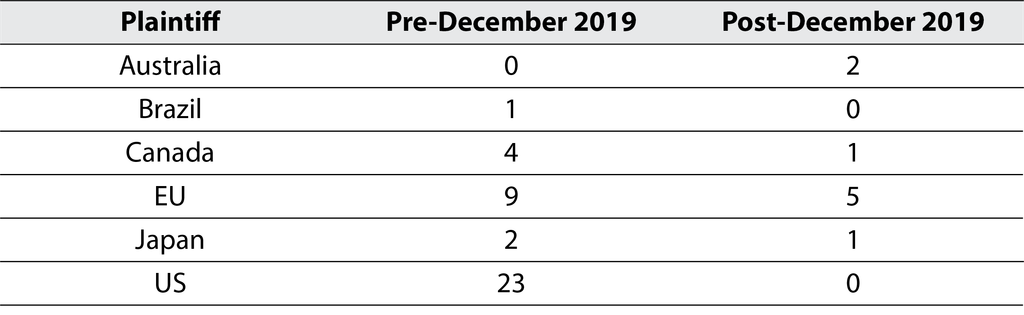
The most frequent plaintiff against China, the United States, has practically absented itself from the WTO, revealing a preference for a bilateral (and often WTO-inconsistent) settlement with China. The US introduced about 40 percent of all complaints against China (23/53), but has not introduced a complaint since 201843. Table 1 shows that other WTO members did make up the shortfall of cases.
Table 1. Complaints against China before and after the demise of the WTO appellate body
Note: see also section 4.2.3.
Source: Bruegel.
The US has taken the view that there is only so much that can be done against China within the WTO, with the Trump administration believing the WTO is ill-equipped to deal with the problems China poses44. This view was current even before the demise in 2019 of the Appellate Body (see for example Wu 2016).
Especially since the first Trump administration, the US has worked regionally, bilaterally, unilaterally but not multilaterally. The US moved gradually away from the multilateral table following its ill-fated complaints against China. Policies since are hard to reconcile with the WTO.
For example, the so-called Phase One agreement the US signed with China in 2020, with the aim of rebalancing trade, went against the non-discrimination principle, the bedrock of the WTO45. Since, the US has imposed unilateral tariffs on goods originating from China and has announced its intention to establish a bilateral (US-China) Board of Trade that de facto will practice ‘managed trade’, with specific volumes of goods traded between the two nations46.
This goes directly against the WTO, which is about providing a framework within which comparative advantage can work, with no specific volumes agreed between the various partners, except in exceptional circumstances (eg. safeguards).
Nevertheless, the view of the US administration has gained prominence. Bown and Keynes (2026) advanced a series of arguments that could help governments minimise losses in the current uncertain circumstances, and even win some trade wars. Engaging in trade wars ipso facto entails disengagement from the WTO, which requires the submission of all disputes to an independent authority by virtue of Article 23.2 of the WTO Dispute Settlement Understanding, the agreement regulating adjudication at the WTO47.
Is the US alone in thinking this way? The EU has adopted a mix of multilaterally-friendly and hostile policies. It introduced in 2022 and 2025 two high-profile, politically sensitive and intellectually challenging against China. In DS611 China-IPRs Enforcement (EU), the main question concerned the permissible scope of anti-suit injunctions by Chinese courts48. In DS632 China-SEPs (EU), the treatment of standard-essential patents (SEPs) is at the heart of the EU dispute with China49.
In both cases, the WTO panel was asked to deal with a novel issue. But in September 2026, the EU seemed to follow the US when asking China to ‘voluntarily’ reduce its exports of hybrid cars50. Grey area measures like voluntary export restraints (VERs), besides their shaky economic foundations, are also blatantly illegal under the WTO contract as per Article 11 of the WTO Agreement on Safeguards51.
Irrespective of what the EU’s next steps are, the US decision to practically check out from the WTO largely explains the falling number of complaints against China.
4.2.3 A ‘fragmentation doom loop’ following the de-facto US departure?
Clayton et al (2024) defined ‘fragmentation doom loop’ as follows:
“As each country breaks away from the globally integrated system, the system itself becomes less attractive to all other participants, increasing the incentives of other countries to also break away. The resulting fragmentation is inefficient as each country over-secures its own economy.”
Since December 2019, when the WTO Appellate Body went into abeyance following the first Trump administration’s decision to stop re-appointing members whose terms had expired, losers before a WTO panel can appeal ‘into the void’, depriving hostile panel reports of any practical significance as there is no body to hear appeals.
Anticipating the risk of similar behaviour, WTO members litigate much less. Between January 1995 and December 2019, 592 requests for consultations were submitted – an average of 23 to 24 per year. Since December 2019, only 53 requests have been made, or eight to nine per year on average.
Sixty WTO members have signed on to the Multi Party Interim Agreement (MPIA), which provides for an ersatz appellate mechanism. China is one of them. But by time of writing, 106 WTO members had not joined the MPIA52.
The EU (and to some extent, Australia) emerges as the only prominent complainer against China since 2019 (Table 1).
It is debatable whether a fragmentation doom loop is underway. The WTO still has an address in Geneva, and its committees produce useful work. Rajan (2023) has argued persuasively that the WTO should not be abandoned. Much can still be achieved within the current regime. However, the WTO finds it increasingly hard to legislate while its adjudicative function has been weakened. The value of adjudication before the WTO has been reduced as major players (chiefly the US but also middle powers including India and Korea) have decided to stay out of the MPIA53.
4.3 Multilateral solutions require cooperation between multilateral institutions
Though China has changed hugely since the 1986 start of negotiations to discuss its accession to the GATT, the role of the state continues to be important and different when compared to Western liberal states. SOEs have a higher share of the market in China than the OECD mean, and China subsidises more and more widely than its Western partners (OECD 2026a).
In this context, there is only so much the WTO can do. Barfield (2003) and Hufbauer and Jung (2021) showed that the rise of Japan in the 1980s, which presented the world community with issues similar to the ‘China problem’, was not ‘tamed’ through trade instruments. In 1985, in Hotel Plaza in New York City, the Plaza Accord was signed by France, Germany, the US, the United Kingdom and Japan.
The idea was to de-value the dollar against the yen and deutschmark. The dollar depreciated and the yen and deutschmark appreciated. The US deficit was eased. Subsequently, the Louvre Accord was signed, which aimed to stabilise the dollar. Since then, no one in the US has complained about the ‘Japan problem’.
This was not the first time that a trade problem was resolved through a concerted effort by various institutions. In 1972, the Smithsonian Agreement put an end to the ‘Nixon shock’ which was expressed as an (unannounced to its trading partners) import surcharge. As we have shown, the China issue can only be addressed through a similar effort.
The world community should contemplate a Plaza II accord. A multilateral negotiated solution is always preferable to bilateral deals that often lead to skirmishes, mini-wars, ongoing threats and mistrust.
There is another reason why the ‘China problem’ should not be dealt with exclusively under the WTO. Barfield (2001) first argued that the germ of self-subversion of multilateral institutions lies in the discrepancy between a strong judiciary and a weak legislative arm. ‘Agents’ (adjudicators) cannot and should not lead the ‘principals’ (WTO members). A negotiated solution offers legitimacy that an imposed judgment does not.
A forgotten GATT story could serve as a lesson for the WTO today. In the early 1950s, Norway and Denmark complained against Belgium. The panel on Belgian family allowances54 was presented with an unusual request. Was Belgium, by levying a duty on imports from the plaintiffs, but not from the Netherlands or Luxembourg (and a few other countries) violating MFN?
There is no mention of specific products in the report and the was intended to test the scope of the GATT. Should the MFN obligation extend to all government measures, even if they tangentially only affect trade? Should it extend to any government intervention? In equilibrium, all policy instruments, at least potentially and/or indirectly affect trade.
The panel’s response was ambiguous, and could be seen as an attempt to throw the question back to the negotiators. There was not enough law for the adjudicators to provide a decisive response. The picture has not changed much since and the problems have continued. The question of whether importers can adjust their taxes at the border to address regulatory differences came back again and again in GATT practice and in GATT Working Party reports (Meade 1974).
One could probably argue that the Norwegian/Danish question about Belgium came too early. And yet, the GATT membership showed remarkable maturity in handling the aftermath to the panel report. It established a Working Party on Border Tax Adjustments, which debated the issue on its merits and came up with a partial response that shaped GATT practice.
The experience is considered a success precisely because the membership did not shy away from the question. Note, the two most powerful GATT members at the time, the US and the European Community, were at loggerheads on this score (Grossman, 1980). They sat together, formulated precise questions, and answered them (or almost) one by one.
Endnotes
1. See for example Ryan McMorrow, Sam Fleming, Peter Foster and John Leahy, ‘China shock 2.0: the flood of high-tech goods that will change the world’, The Financial Times, 14 April 2026.
2. To avoid misunderstandings, we do not side with those who believe that trade deficits per se are problematic, but assess the argument that the WTO cannot help trading nations address China’s policies that have provoked deficits.
3. For example, the US in the past made use of the possibility to cross-notify subsidies under the SCM (see footnote 2). In 2011, the US notified the WTO of 42 green technology schemes, 92 export subsidies and 52 other schemes belonging to various categories. However, it has not followed up with similar cross-notifications. One can only speculate whether China has started complying with the SCM transparency obligations (in which case the alleged lack of transparency is no more an issue), or whether China has become savvier in concealing information (in which case the problem has been exacerbated). See WTO Doc. G/SCM/Q2/CHN/42 of 11 October 2011.
4. See WTO press release of 10 November 2001, ‘WTO Ministerial Conference approves China’s accession’.
5. Annex 6 of China’s Protocol of Accession, WTO Doc. WT/L/432 of 23 November 2001.
6. As part of WTO reform proposals, the EU has called for the obligation to act in accordance with commercial considerations to be extended to SOEs; see WTO Doc. WT/GC/REFORM/W/5 of 13 July 2026. See also Simon Lester, ‘EU WTO Reform Proposal Seeks to Extend Accession-Based State Enterprise Rules to All Members’, International Economic Law and Policy Blog, 17 July 2026.
7. WTO Doc. WT/ACC/CHN/49, 1 October 2001, p. 8 et seq (WTO, 2001).
8. Rotunno et al (2026) focused on direct grants and thus likely underestimated the amounts paid to strategic sectors by China, as typically lower interest rates are paid to industrial goods, not to farm support.
9. Using value-added as a metric also leads to lower numbers (Jakubik and Stolzenburg 2018). Similarly, James Heckman and Hanming Fang claimed calculated job losses in the US were probably overestimated; see James Heckman and Hanming Fang, ‘The Real Story of the China Shock’, Commentary, 27 May 2025, Archbridge Institute. Kai Guo cautioned that it is not subsidies that explain China’s success, but rather their interaction with human capital, innovation and market scale. See Kai Guo, ‘Subsidies Do Not Explain China’s Competitiveness’, Project Syndicate, 17 July 2026. Jaravel and Sager (2018) showed that for every manufacturing job lost as per the Autor et al (2013) calculations, US firms generated benefits up to $101,250.
10. Ruggie (1982) explained “embedded liberalism”, the heart and soul of the GATT, as balancing free-market openness with the domestic welfare state. On this issue, see also Zeiler (1999).
11. WTO Doc. WT/DSB/M/505 of 14 October 2025 at §2.3. See WTO, ‘DS611: China — Enforcement of Intellectual Property Rights’.
12. To draw a parallel here, the former communist eastern European countries did not transform into market economies because of their accession to GATT. GATT had no tools to require that. The WTO continued to be a negative integration contract with no mandate to recommend such policy changes to newly acceding countries. In that, there was no difference between GATT and the WTO.
13. On this, see also the discussion in Lincicome (2020). Kostecki (1979) argued persuasively that one of the reasons that GATT incumbents let in then-communist eastern European countries was to bring them to a more lucrative way of living, lure them if possible into the Western bloc and thus weaken the Soviet bloc. It did not work. This lesson should have been learned by those in charge when China was negotiating its accession to the WTO.
14. Nick Lardy, ‘Xi Jinping’s turn away from the market puts Chinese growth at risk’, Financial Times, 15 January 2019.
15. Cosbey and Mavroidis (2014) inquired into the historical context when the decision not to renew Article 8 took place, and concluded there was no discernible reason justifying this decision, other than the fact that no WTO member had availed itself of this possibility until then. But lack of interest could be the consequence of imprecise drafting and the ensuing fear of providing self-incriminating information.
16. In an excellent analysis, which is critical of the current multilateral regime, Hoekman and Nelson (2024) discussed how non-economic objectives can be achieved through the use of trade instruments.
17. See WTO, ‘DS616: European Union — Countervailing and Anti-Dumping Duties on Stainless Steel Cold-Rolled Flat Products from Indonesia’.
18. In Mavroidis and Sapir (2021), we added that the WTO framers should not be accused of short-sightedness simply because their appointed agents (the WTO Appellate Body) mis-interpreted key notions such as ‘public body’ and exonerated dubious Chinese practices from prosecution. The practices of hundreds of Chinese SOEs would have been judged unlawful had the Appellate Body got it right in this respect. But all that is required here is a simple rule change.
19. See WTO, ‘DS379: United States — Definitive Anti-Dumping and Countervailing Duties on Certain Products from China’.
20. See WTO, ‘DS437: United States — Countervailing Duty Measures on Certain Products from China’.
21. For ‘weaponisation’ of trade policy to be effective, asymmetric costs are one of the conditions to be met. Asymmetry played a major role in China’s ultimate decision to retaliate against US tariffs imposed by the Trump administration and US restrictions on exports of high-end semiconductors. Fishman (2026) noted that China would forego only $2 billion by stopping exports of neodymium (a rare earth element used in the production of strong magnets), but would inflict damage of $600 billion. No wonder China chose the ‘nuclear option’ and stopped supplies for a short while, only for President Trump to almost immediately back-track from his announced policies against China. Unsurprisingly thus, when faced with trade-restrictive measures in the final-goods market, China moved to restrict trade in the input.
22. WTO, ‘DS394: China — Measures Related to the Exportation of Various Raw Materials’.
23. WTO, ‘DS431: China — Measures Related to the Exportation of Rare Earths, Tungsten and Molybdenum’.
24. Of course, stopping China from practicing REE export bans does not automatically lead to economic security for those that depend on Chinese imports. Pisani-Ferry et al (2024) advanced some imaginative proposals on how to achieve de-risking.
25. WTO, ‘Japan – Trade in Semiconductors’, GATT Doc. L/ 6309, BISD 35S/116.
26. See https://www.steelforum.org/.
27. The Economist, ‘Why the IMF’s newest report finds that the yuan is undervalued’, 19 February 2026.
28. Mavroidis (2016) explained how GATT/WTO panels have sometimes been totally deferential to IMF expertise and sometimes not.
29. As noted by Oliver Kim, ‘Does China Underconsume?’ Global Developments, 12 August 2025.
30. See Lundgreen’s Investor Insights, ‘China’s consumption pitch met with reluctance’, 4 May 2026.
31. A violation complaint is a complaint in which the plaintiff claims that the respondent has committed an illegality by adopting a behaviour proscribed by law.
32. UN Doc. EPCT/A/PV/5, p.14.
33. GATT Doc. L/5479 of 8 April 1983, p.2.
34. GATT Doc. C/M/167 of 6 May 1983, p.9.
35. According to this rule, a panel will be established and its report will always be adopted, unless all of the WTO membership (eg. the party requesting the establishment and/or the adoption of its output) opposes it.
36. See WTO, ‘DS44: Japan — Measures Affecting Consumer Photographic Film and Paper’.
37. See WTO, ‘Disputes by member’.
38. WITS, ‘China trade statistics’.
39. On this issue, see the very useful analysis of Bown and Keynes (2020).
40. Mavroidis (2022) calculated the total amount of litigation to correspond to roughly four years in the best of all circumstances.
41. See WTO, ‘Disputes by member’.
42. WTO, ‘DS390: China — Grants, Loans and Other Incentives’.
43. The last complaint against China from the US was WTO, ‘DS558: China — Additional Duties on Certain Products from the United States’.
44. See for example Jamieson Greer, ‘Another Fish Story From the WTO’, Wall Street Journal, 7 April 2026.
45. See Office of the US Trade Representative, ‘Rebalancing United States-China Trade’.
46. See The White House factsheet of 17 May 2026, ‘President Donald J. Trump Secures Historic Deals with China, Delivering for American Workers, Farmers, and Industry’. At time of writing, the precise terms of the Board of Trade have not been agreed. Judging by past experience, the Phase One agreement and declarations so far, one can reasonably expect some form of ‘managed trade’ to permeate the letter and the spirit of this Board; see Gary Clyde Hufbauer, ‘Managed trade: Centerpiece of US-China phase one deal’, Trade & Investment Policy Watch, 16 January 2020, Peterson Institute for International Economics.
47. See WTO, ‘Understanding on Rules and Procedures Governing the Settlement of Disputes’.
48. WTO, ‘DS611: China — Enforcement of Intellectual Property Rights’.
49. WTO, ‘DS632: China — Worldwide Licensing Terms for Standard Essential Patents’.
50. Andy Bounds and Joe Leahy, ‘EU Asks China to Voluntarily Limit Hybrid Cars Exports’, Financial Times, 17 September 2026.
51. See WTO, ‘Agreement on Safeguards’.
52. For a detailed discussion of the MPIA, see Mavroidis (2026).
53. Future prospects for WTO adjudication are uncertain. The US and EU have become more closely aligned on the future role of the MFN, the cornerstone of the WTO, while China and the EU still buy into the idea of compulsory third-party adjudication, which is embedded in Article 23.2 of the Dispute Settlement Understanding. The US and China disagree on both counts.
54. See GATT, ‘Belgian family allowances’, GATT Doc. G/32 BISD 1S/59, report adopted on 7 November 1952.
References
Autor, DH, D Dorn and GH Hanson (2013) ‘The China Syndrome: Local Labor Market Effects of Import Competition in the United States’, American Economic Review 103: 2121–2168.
Bacchus, J, S Lester and H Zhu (2018) ‘Disciplining China’s Trade Practices at the WTO: How WTO Complaints Can Help Make China More Market-Oriented’, mimeo.
Barfield, CE (2001) Free Trade, Sovereignty, Democracy: The Future of the World Trade Organization, The AEI Press.
Barfield, CE (2003) High-Tech Protectionism, the Irrationality of Antidumping Laws, American Enterprise Institute.
Bown, CP (2009) ‘U.S.–China Trade Conflicts and the Future of the WTO’, Fletcher Forum of World Affairs 33: 27-48.
Bown CP and JA Hillman (2019) ‘WTO’ing a Resolution to the China Subsidy Problem’, Journal of International Economic Law 22(4): 557–578.
Bown CP and S Keynes (2020) ‘Why Trump Shot the Sheriffs: The End of WTO Dispute Settlement’, Journal of Policy Modelling 42(4): 799-819.
Caliendo, L, M Dvorkin and F Parro (2019) ‘Trade and Labor Market Dynamics: General Equilibrium Analysis of the China Trade Shock’, Econometrica 87(3): 741-835.
Caliendo, L and F Parro (2023) ‘Lessons from U.S.-China Trade Relations’, Annual Review of Economics 15: 513-547.
Carvalho, C, D Monte and E Ornelas (2025) ‘Equilibrium trade regimes: power- vs. rules-based’, CEP Discussion Paper 2128, Centre for Economic Performance, London School of Economics and Political Science.
Clayton, C, M Maggiori and J Schreger (2024) ‘A Theory of Economic Coercion and Fragmentation’, BIS Working Paper 1224, Bank for International Settlements.
Cosbey, A and PC Mavroidis (2014) ‘A Turquoise Mess: Green Subsidies, Blue Industrial Policy, and Renewable Energy; The Case for Redrafting the Subsidies Agreement of the WTO’, Journal of International Economic Law 17(1): 11-47.
Ethier, WJ (2006) ‘Punishments and Dispute Settlement in Trade Agreements, The Equivalent Withdrawal of Concessions’, Keio Economic Studies 42(1/2): 1–23.
Fishman, E (2026) ‘How to Fight an Economic War’, Foreign Affairs, 21 April.
Fritz, J and S Evenett (2021) ‘Subsidies and Market Access: New Data and Findings from the Global Trade Alert’, VoxEU, 25 October.
Grossman, GM (1980) ‘Border tax adjustments: Do they distort trade?’ Journal of International Economics, 10(1) :117–128.
Harrell, P, E Resenberg and E Saravalle (2018) China’s Use of Coercive Economic Measures, Center for a New American Security.
Hillman, J (2018) ‘The Best Way to Address China’s Unfair Policies and Practices is Through a Big, Bold Multilateral Case at the WTO’, Testimony Before the U.S.-China Economic and Review Security Commission, 18 June.
Hoekman, BM and DR Nelson (2025) ‘Industrial Policy and International Cooperation’, World Trade Review 24(2): 136–152.
Horn, H, PC Mavroidis and H Nordstrøm (2005) ‘Is the Use of the WTO Dispute Settlement System Biased?’ in PC Mavroidis and AO Sykes (eds) The WTO and International Trade Law Dispute Settlement, Elgar Publishing.
Hufbauer, GC and E Jung (2021) ‘Scoring 50 Years of US Industrial Policy, 1970-2020’, PIIE Briefing 21-5, Peterson Institute for International Economics.
Irwin, DA (2012) ‘The Nixon Shock After Forty Years: the Import Surcharge Revisited’, World Trade Review 12(1): 29-56.
Irwin, DA, PC Mavroidis and AO Sykes (2008) The Genesis of the GATT, Cambridge University Press.
Jakubik, A and V Stolzenburg (2018) ‘The “China Shock” Revisited: Insights from Value Added Trade Flows’, Staff Working Paper ERSD-2018-10, World Trade Organization.
Jaravel, X and E Sager (2018) ‘What are the Price Effects of Trade? Evidence from the US and Implications for Quantitative Trade Models’, Working Paper 506, Bureau of Labor Statistics.
Keynes, S and CP Bown (2026) How to Win a Trade War, An Optimistic Guide to an Anxious Global Economy, Simon and Schuster.
Kostecki, MM (1979) East/West Trade and the GATT System, Palgrave Macmillan.
Lincicome, S (2020) ‘Testing the “China Shock”: Was Normalizing Trade with China a Mistake?’ Policy Analysis 895, CATO Institute.
Mattoo, A and A Subramanian (2008) ‘Currency Undervaluation and Sovereign Wealth Funds: A New Role for the World Trade Organization’, Working Paper 08-2, Peterson Institute for International Economics.
Mavroidis, PC (2016) The Regulation of International Trade, Volume 1: GATT, MIT Press.
Mavroidis, PC (2022) The WTO Dispute Settlement System, How, Why and Where? Elgar Publishing.
Mavroidis, PC (2025) Industrial Policy, National Security, and the Perilous Plight of the WTO, Oxford University Press.
Mavroidis, PC (2026) ‘Adjudicating Trade Disputes: The Multi-Party Interim Arrangement (MPIA) – Back to the Past?’ RSC Working Paper 2026/28, EUI Robert Schuman Centre.
Mavroidis, PC and A Sapir (2021) China and the WTO: Why Multilateralism Still Matters, Princeton University Press.
Meade, J (1974) ‘A Note on Border-Tax Adjustments’, Journal of Political Economy 82(5):1013–1015.
OECD (2026a) OECD MAGIC Database of Industrial Subsidies, Organisation of Economic Co-operation and Development.
OECD (2026b) OECD Steel Outlook 2026, Organisation for Economic Co-operation and Development.
Olson, M (1965) The Logic of Collective Action, Public Goods and the Theory of Groups, Harvard University Press.
Pisani-Ferry, J, B Weder di Mauro and J Zettelmeyer (2024) ‘How to de-risk: European economic security in a world of interdependence’, Policy Brief 07/2024, Bruegel.
Rajan, RG (2023) ‘The Gospel of Deglobalization’, Foreign Affairs, 20 December.
Rotunno, L, M Ruta and P Verma (2026) ‘Industrial Policy and Trade Tensions in Strategic Sectors’, Working Paper 2026/155, International Monetary Fund.
Ruggie, JG (1982) ‘International Regimes, Transactions, and Change: Embedded Liberalism in the Postwar Economic Order’, International Organization 36(2): 379–415.
Stiglitz, JE and A Charlton (2006) Fair Trade for All: How Trade Can Promote Development, Oxford University Press.
Staiger, RW and AO Sykes (2017) ‘How Important Can the Non-Violation Clause Be for the GATT/ WTO?’ American Economic Journal: Microeconomics 9(2): 149-187.
Williams, PJ (2008) A Handbook on Accessions to the WTO, Cambridge University Press.
Wolfe, R (2010) ‘Letting the Sunshine in the WTO, How Transparency Bring the Trading System to Life’, Staff Working Paper ERSD 2013-03, World Trade Organization.
WTO (2001) Report of the Working Party on the Accession of China, WT/ACC/CHN/49, World Trade Organization.
Wu, M (2016) ‘The “China Inc.” Challenge to World Trade Governance’, Harvard Journal of International Law 57: 261–324.
Zeiler, TW (1999) Free Trade, Free World: The Advent of GATT, University of North Carolina Press.
Zhou, W (2016) ‘Fifteen Years On: Has China Implemented WTO Rulings? — A Perspective on “Trade in Goods” Disputes’, Asian Journal of WTO & International Health Law and Policy 11(1): 155-212.
I would like to thank Emily Blanchard, Ignacio Garcia-Bercero, Martina Ferracane, Hans Geeroms, Merit Janow, Simon Lester, Inu Manak, Shagun Mehrotra, Stratos Pahis, Camille Reverdy, André Sapir, Nicolas Veron, Guntram Wolff and especially Jeromin Zettelmeyer for helpful discussions and/or comments on previous drafts. This article is based on a Bruegel Working Paper.